Home Workout No Equipment: A Complete Beginner Guide
A home workout with no equipment can build real strength. Get the 6 key moves, a 3-day sample week and a 4-week progression plan you can start today.
By Home Workout Planner Team · · 13 min read
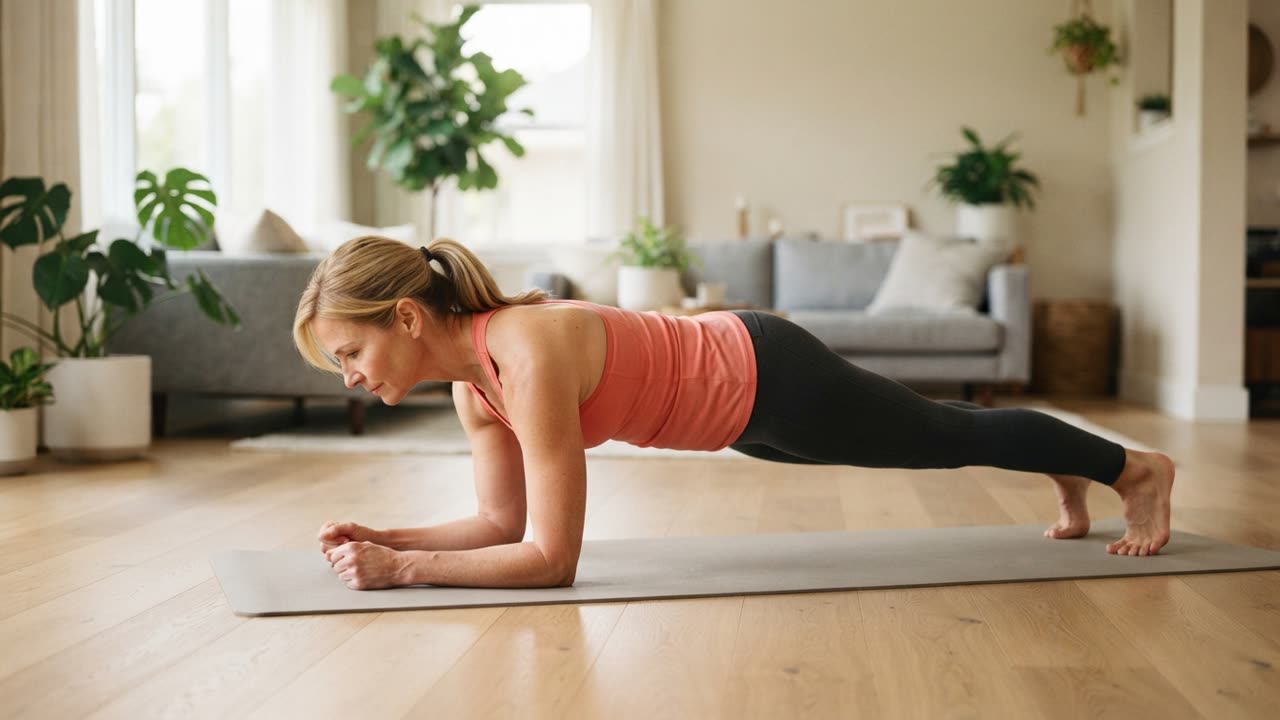
A home workout with no equipment can build real strength and fitness if you cover every major movement pattern and make the exercises harder over time. Three full-body sessions a week, about 30 to 40 minutes each, plus regular walking, is enough for most beginners to see clear progress.
This guide is for adults who are new to training or coming back after a long break and want a plan they can follow in a living room. You will get the six moves that matter, a ladder of easier and harder versions for each, a sample week, two workouts and a four-week progression.
Can you really get fit at home without equipment?
Yes. Your muscles respond to effort and tension, and your body weight provides plenty of both once you choose the right variation.
The research backs this up. In a small eight-week study, push-ups and a low-load bench press produced similar muscle growth and strength gains in 18 young men who trained twice a week, doing 3 sets to failure. A 2017 meta-analysis of 21 studies found that muscle growth was similar with light and heavy loads when sets were taken to failure, while heavy loads did better for maximal strength.
So bodyweight training builds muscle well, as long as each set is hard. Where it falls short is top-end strength (a heavy one-rep squat, for example) and some pulling movements, which we cover below. If muscle gain is your main goal, read our guide on whether you can build muscle with bodyweight for the details.
How much exercise do you need each week?
The World Health Organization’s 2020 guidelines give adults two targets:
- 150 to 300 minutes of moderate aerobic activity a week (or 75 to 150 minutes of vigorous activity, or a mix).
- Muscle-strengthening activity at moderate or greater intensity that works all major muscle groups, on 2 or more days a week.
A home plan should hit both. Three short strength sessions cover the second target. Brisk walking, stair climbing or a no-jump cardio circuit covers the first.
For beginners specifically, the American College of Sports Medicine’s position stand on resistance training progression recommends training 2 to 3 days a week and using a load you can lift for 8 to 12 repetitions. With body weight, “load” means picking the variation that makes 8 to 12 reps hard. That rule drives the whole plan below.
What are the best no equipment exercises for beginners?
You do not need dozens of exercises. You need one exercise from each of six movement patterns, done at the right level of difficulty. Here are the patterns, with the beginner version and where it goes next.
1. Squat
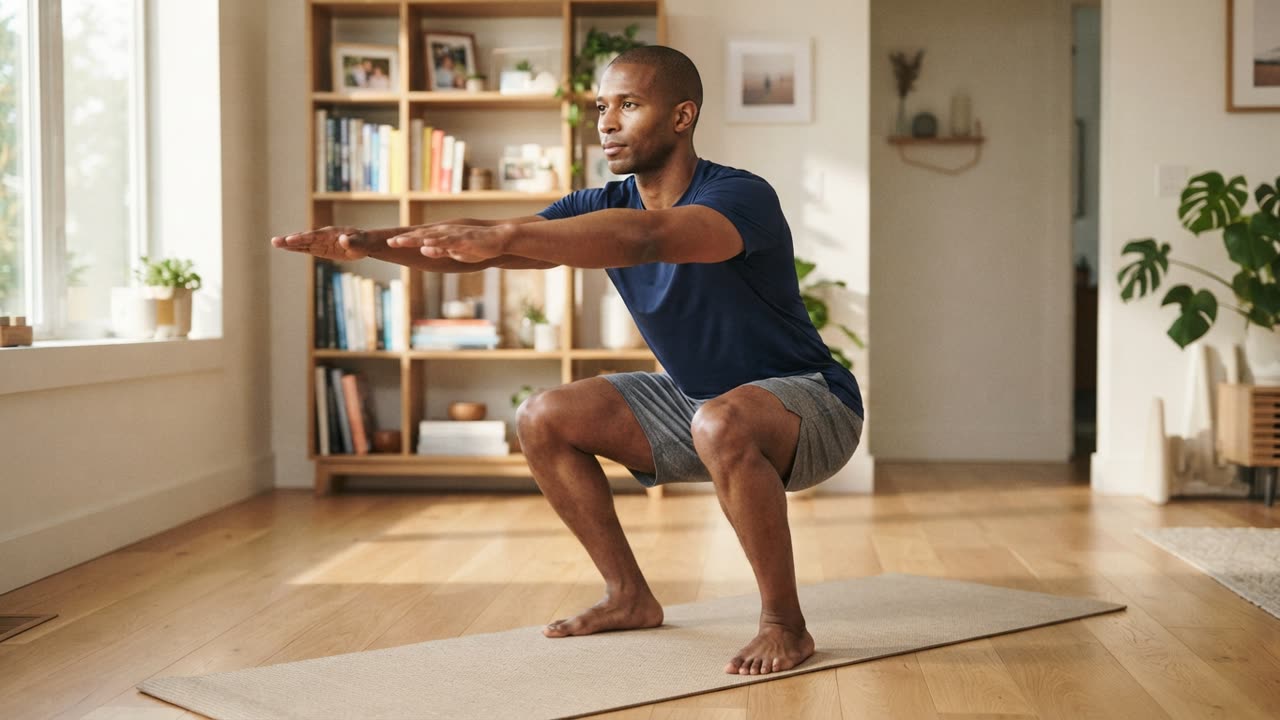
The squat trains your thighs and glutes and carries over to standing up, climbing stairs and lifting things off the floor.
- Start with: a box squat. Sit back to a chair, touch it lightly, and stand up without rocking.
- Form cues: feet about shoulder-width apart, knees track in line with your toes, chest up, heels down.
- Next: bodyweight squat, then a pause squat (hold 2 to 3 seconds at the bottom).
2. Hip hinge
Hinging trains the back of your body: glutes, hamstrings and lower back. Most beginners under-train it.
- Start with: a glute bridge. Lie on your back, knees bent, and drive your hips up until your body forms a straight line from knees to shoulders.
- Form cues: push through your heels, squeeze your glutes at the top, keep your ribs down so your lower back does not arch.
- Next: single-leg glute bridge, then a shoulders-elevated hip thrust with your upper back on a couch.
3. Lunge
Single-leg work builds balance and evens out side-to-side differences.
- Start with: a reverse lunge holding a wall or chair for balance. Step back, lower until both knees are bent, push back up through the front foot.
- Form cues: keep most of your weight on the front leg, torso tall, front knee over the middle of the foot.
- Next: reverse lunge without support, split squat, then a Bulgarian split squat (rear foot on a couch or bed).
4. Push
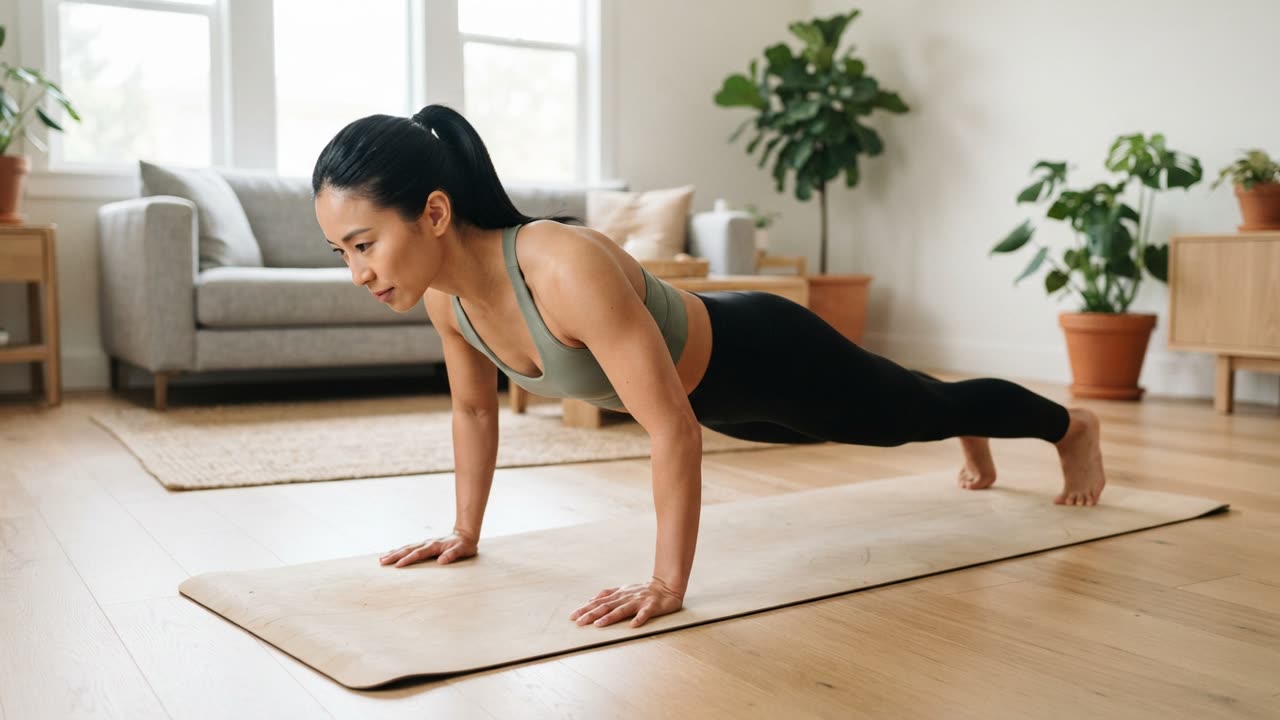
Push-ups train the chest, shoulders and triceps, and they are easy to scale.
- Start with: an incline push-up with your hands on a kitchen counter. The higher the surface, the easier it is.
- Form cues: hands slightly wider than shoulders, body in one straight line, lower your chest (not your head) toward the surface.
- Next: lower the surface (table, then sturdy chair), then knee push-ups or full push-ups on the floor, then feet-elevated push-ups.
5. Pull
Pulling is the hardest pattern to train without gear. These moves still work your upper back and help your posture.
- Start with: prone Y-T-W raises. Lie face down, lift your arms into a Y, then a T, then a W shape, squeezing your shoulder blades each time.
- Form cues: keep your forehead on a towel, lift with your upper back, and move slowly.
- Next: reverse snow angels (sweep your arms from overhead to your hips while lifted), then a superman hold.
If you want a real horizontal row, the safest option is a doorway pull-up bar or a resistance band. Avoid rowing under a table or from a door unless you are certain it will hold your full weight.
6. Core
Your core’s main job is to resist movement and keep your spine steady while your arms and legs move.
- Start with: a dead bug. Lie on your back, arms up, knees bent at 90 degrees, and slowly lower the opposite arm and leg while pressing your lower back into the floor.
- Form cues: breathe out as you extend, keep your lower back in contact with the floor, move slowly.
- Next: front plank, side plank, then a hollow body hold.
How do you make bodyweight exercises harder without weights?
This is where most home programs fall apart. If you do the same 10 squats forever, your body stops adapting. Progression is what turns a routine into a program.
You have six levers. Pull one at a time:
- Add reps. Go from 8 to 12 reps on every set.
- Add a set. Move from 2 sets to 3.
- Slow the lowering phase. Take 3 seconds to lower into each squat or push-up.
- Add a pause. Hold the bottom position for 2 seconds, where you are weakest.
- Change the leverage. Lower the push-up surface, raise the hips in a bridge onto a couch.
- Go single-leg or single-arm. A split squat loads each leg with much more of your body weight than a two-leg squat.
The rule that ties it together comes from the ACSM’s 8 to 12 rep guidance: when you can do 12 clean reps on every set, move to the next harder variation and start again at 8. Here is the ladder for each pattern.
| Pattern | Level 1 | Level 2 | Level 3 | Level 4 |
|---|---|---|---|---|
| Squat | Box squat to chair | Bodyweight squat | Pause squat | Split squat |
| Hinge | Glute bridge | Single-leg glute bridge | Shoulders-elevated hip thrust | Single-leg hip thrust |
| Lunge | Supported reverse lunge | Reverse lunge | Split squat | Bulgarian split squat |
| Push | Counter push-up | Table push-up | Floor push-up (knees or full) | Feet-elevated push-up |
| Pull | Prone Y-T-W | Reverse snow angel | Superman hold | Band or bar row (equipment) |
| Core | Dead bug | Front plank | Side plank | Hollow body hold |
You do not need to be at the same level in every row. You might start at Level 2 for squats and Level 1 for push-ups, and that is fine.
How hard should each set feel?
Hard enough that the last two reps slow down. The muscle-growth research above used sets taken to failure, but you do not need to grind every set to the point where your form breaks.
A practical target for beginners is to stop each set when you could do 1 to 3 more good reps. Use the last set of each exercise to test yourself: if you blow past 12 reps with easy form, the variation is too easy.
How long should you rest between sets?
About 60 to 90 seconds works well for most home sessions. A 2024 meta-analysis on rest intervals found a small muscle-growth benefit from resting longer than 60 seconds, and no clear extra benefit beyond 90 seconds.
If you are short on time, pair two exercises that use different muscles (a squat and a push-up, for example) and alternate between them. You rest one area while working the other.
Sample week: home workout, no equipment needed
This week covers both WHO targets: three strength sessions and well over 150 minutes of moderate activity once you add the walks.
| Day | Session | Time |
|---|---|---|
| Monday | Workout A + 10-minute brisk walk | 40 to 50 min |
| Tuesday | Brisk walk or no-jump cardio | 40 min |
| Wednesday | Workout B + 10-minute brisk walk | 40 to 50 min |
| Thursday | Brisk walk or no-jump cardio | 40 min |
| Friday | Workout A + 10-minute brisk walk | 40 to 50 min |
| Saturday | Longer walk, hike or bike ride | 50 min |
| Sunday | Rest or gentle stretching | Optional |
In the following week, swap the order: B, A, B. Over two weeks you do each workout three times.
If three strength days do not fit, two still meets the WHO minimum. Keep them at least one day apart.
Workout A: full body (squat, push, pull focus)
Warm up first (see below), then do the exercises in order. Use the level from the ladder that makes the rep target hard.
| Exercise | Sets x reps | Rest |
|---|---|---|
| Squat (your level) | 3 x 8 to 12 | 60 to 90 s |
| Push-up (your level) | 3 x 8 to 12 | 60 to 90 s |
| Glute bridge (your level) | 3 x 8 to 12 | 60 to 90 s |
| Prone Y-T-W raise | 3 x 8 to 12 | 60 s |
| Dead bug | 2 x 6 to 8 per side | 45 s |
| Front plank | 2 x 20 to 30 s | 45 s |
Workout B: full body (lunge, hinge, core focus)
| Exercise | Sets x reps | Rest |
|---|---|---|
| Reverse lunge (your level) | 3 x 8 to 12 per leg | 60 to 90 s |
| Single-leg glute bridge | 3 x 8 to 12 per leg | 60 to 90 s |
| Incline or pike push-up | 3 x 8 to 12 | 60 to 90 s |
| Reverse snow angel | 3 x 8 to 12 | 60 s |
| Side plank | 2 x 15 to 30 s per side | 45 s |
| Bird dog | 2 x 6 to 8 per side | 45 s |
A pike push-up is a push-up with your hips raised high so your body makes an upside-down V. It shifts the work toward your shoulders. Start with your hands on a step or low couch if the floor version is too hard.
If you would rather not track sets and levels yourself, the app has 79 no-equipment workout plans with video demos for every exercise, so you can follow a session and check your form at the same time.
4-week progression for beginners
Use this to structure your first month. The goal of week 1 is to learn the movements, not to wear yourself out.
| Week | Sets per exercise | Effort | What changes |
|---|---|---|---|
| 1 | 2 | Stop with 3 reps left | Learn form, find your level on each ladder |
| 2 | 3 | Stop with 2 reps left | Add the third set |
| 3 | 3 | Stop with 1 to 2 reps left | Add reps, or slow the lowering to 3 seconds |
| 4 | 3 | Stop with 1 to 2 reps left | Move up a level on any exercise where you hit 12 reps on all sets |
After week 4, keep repeating weeks 3 and 4: add reps until you hit 12, then move up a level. Write down your level, sets and reps after each session. A notebook works, and so does a workout log in your phone.
How do you warm up for a home workout?
Five minutes is enough. The aim is to raise your body temperature and rehearse the movements you are about to load.
- March on the spot or walk around your home for 2 minutes.
- Do 10 arm circles forward and 10 backward.
- Do 10 easy box squats to a chair.
- Do 10 glute bridges.
- Do 5 to 8 counter push-ups.
Then start your first exercise. Your first set is often the best time to check form, so keep it smooth.
What cardio can you do at home without equipment?
Brisk walking is still the easiest way to rack up aerobic minutes, and it counts toward the WHO target. If you want to stay indoors, build a simple circuit.
No-jump option (good for apartments): march with high knees, step-ups on the bottom stair, shadow boxing, squat to calf raise. Do each for 40 seconds, rest 20 seconds, and repeat the circuit 4 to 6 times.
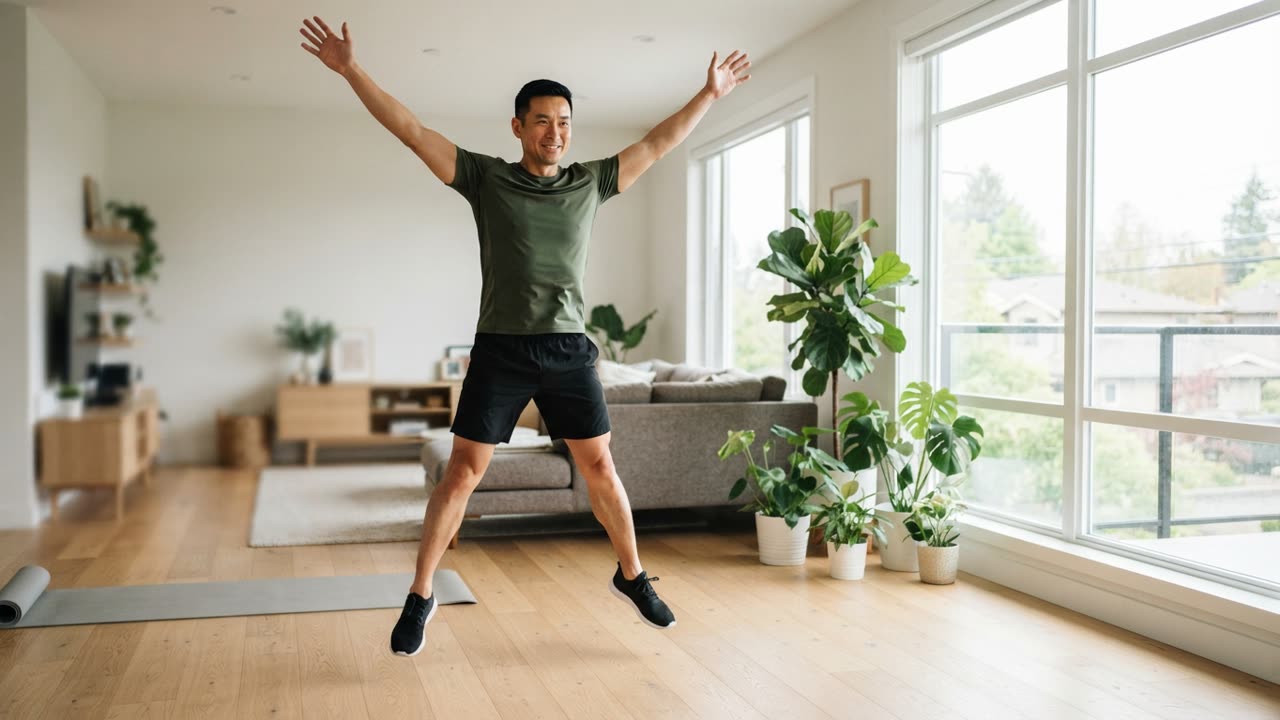
Higher-impact option: jumping jacks, fast feet, skaters and burpees. Only add these once your joints feel fine with the strength work, and land softly.
“Moderate” intensity means you can talk but not sing. If you can sing, speed up. If you cannot speak a full sentence, that is vigorous.
How long until you see results from home workouts?
You will likely notice that sessions feel easier and your rep counts climb within the first few weeks. Those numbers are your best early proof that the plan is working, so log them.
Visible muscle change takes longer and varies a lot between people. The push-up study above measured clear muscle growth after 8 weeks of training twice a week, which is a reasonable first checkpoint. Take a photo and note a few rep counts at the start so you have something to compare against.
If fat loss is part of your goal, training helps but your food intake matters more. Learn how to create a calorie deficit and how to count calories without overcomplicating it. For gaining muscle, pair this plan with the eating and recovery basics in how to build muscle for beginners.
What are the most common home workout mistakes?
Doing the same workout at the same difficulty for months. Use the ladder table and move up a level when you hit 12 reps.
Skipping the pull and hinge patterns. Push-ups and crunches are popular, but a balanced plan also trains the back of your body. Keep the bridges and Y-T-W raises in.
Treating every session as cardio. Rushing through circuits with no rest makes the strength exercises easier than they should be. Rest long enough to do quality reps.
Going too hard in week 1. Being very sore for days makes it easy to skip the next session. Start with 2 sets and stop short of failure.
Training through sharp pain. Muscle fatigue and burning are normal. Sharp, pinching or joint pain is not. Stop the exercise, try an easier variation, and see a doctor or physical therapist if it continues.
Is a no equipment workout safe for everyone?
Bodyweight training is a low-risk way to start for most healthy adults. Still, talk to a doctor before starting if you are pregnant, have a heart condition, high blood pressure, diabetes, joint problems or any symptom like chest pain or dizziness during activity.
Clear a space about the length of your body in every direction, move furniture with sharp corners, and use a non-slip surface. If you use a chair or couch for support, push it against a wall so it cannot slide.
Where should you go from here?
Once you have finished the first four weeks, pick one of these next steps:
- Follow the shorter, three-day routine in our full body workout at home for beginners if you want a simpler single-workout plan.
- Add a resistance band or doorway bar to strengthen your pulling.
- Repeat weeks 3 and 4 and keep climbing the ladder until the Level 4 moves feel easy.
Bottom line
A home workout with no equipment works when it covers squat, hinge, lunge, push, pull and core, and gets harder over time. Train full body three days a week, aim for 8 to 12 hard reps per set, and move to a tougher variation once 12 reps feels easy. Add walking to reach 150 minutes of moderate activity a week, and log every session so you can see your progress.
FAQ
Can I do a no equipment home workout every day?
You can move every day, but give the same muscles a rest day between hard strength sessions. Train full body on 3 non-consecutive days and use the days between for walking or light cardio.
How long should a home workout without equipment take?
The sessions in this plan take about 30 to 40 minutes including the warm-up. If you only have 15 minutes, do one round of every exercise and you still get useful work done.
Do I need a mat for bodyweight training?
A mat is helpful for floor moves like bridges, dead bugs and planks, but a folded towel on carpet works too. Wear shoes or train barefoot on a non-slip surface for squats and lunges.
What is the first piece of equipment worth buying?
A doorway pull-up bar or a resistance band, because pulling exercises are the hardest to load with body weight alone. Everything else in this plan works fine without gear for months.
This article is general information, not medical advice. Check with a doctor before starting a new exercise or diet program, especially if you have a health condition or injury.