Can You Build Muscle With Bodyweight Exercises Only?
Can you build muscle with bodyweight exercises? Yes, if sets are hard and you keep progressing. See the research, progression ladders and a sample plan.
By Home Workout Planner Team · · 7 min read
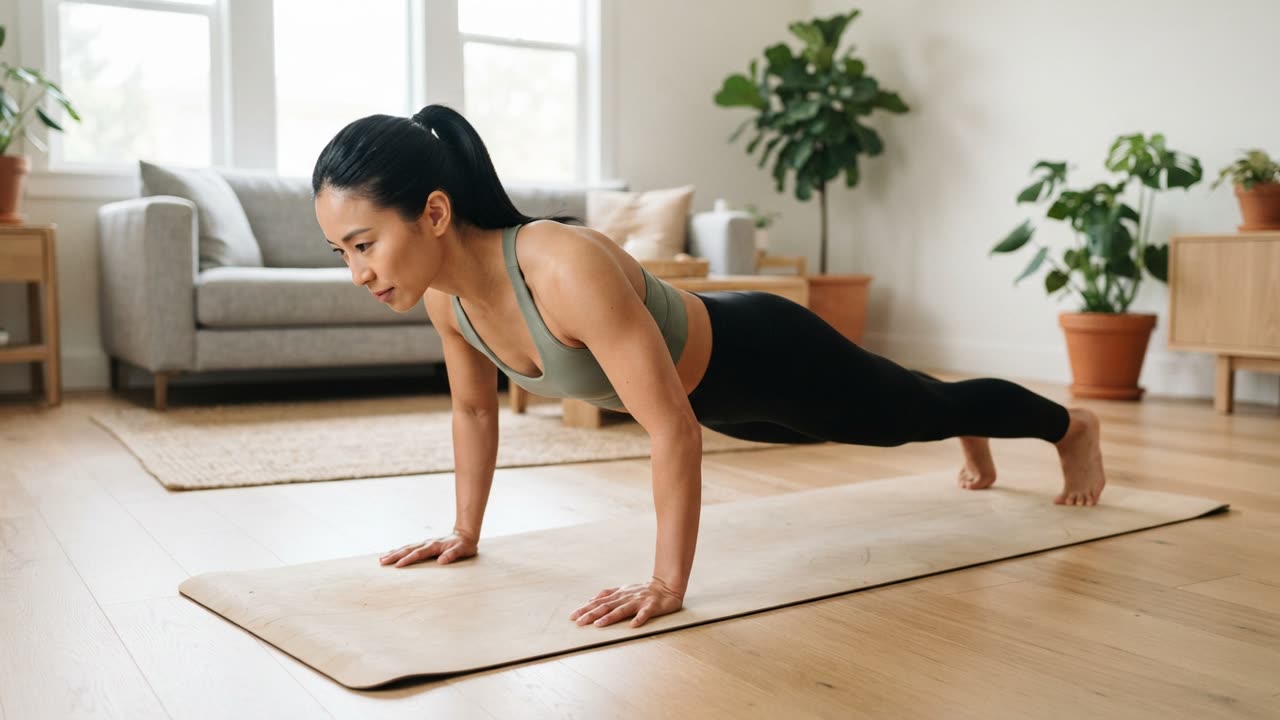
Yes, you can build muscle with bodyweight exercises. Studies show that push-ups can build chest and triceps muscle about as well as a light bench press, and that lighter loads build muscle when sets are taken close to failure. The catch is progression: as you get stronger, you need harder variations to keep growing.
This guide is for beginners and home trainees who want to know what bodyweight training can and cannot do, and how to set it up so it keeps working. If you want the full picture on training, food and recovery, start with our pillar guide on how to build muscle for beginners.
Can you build muscle with bodyweight exercises? What studies show
Three lines of evidence point the same way.
Push-ups versus bench press. In a study by Kikuchi and Nakazato, young men trained twice a week for 8 weeks with either a bench press at 40% of their one-rep max or push-ups adjusted to a similar load. Both groups gained similar chest and triceps thickness and similar strength.
Light loads work when sets are hard. A meta-analysis of low- versus high-load training by Schoenfeld and colleagues compared loads at or below 60% of one-rep max with heavier loads, with all sets taken to muscular failure. Muscle growth was similar between the two. Heavy loads still produced larger gains in maximal strength.
Even high reps can work in trained lifters. In a study of well-trained men, sets of 25 to 35 reps to failure built about as much muscle over 8 weeks as sets of 8 to 12 reps.
There is a floor, though. When Lasevicius and colleagues compared loads from 20% to 80% of one-rep max with volume matched, the 20% condition produced clearly smaller gains in muscle size. Very easy exercises, the kind you could repeat for 50 reps, are unlikely to do much on their own.
So bodyweight training works for muscle if the exercise is hard enough for you, and if you push each set close to failure.
Why does bodyweight training build muscle?
Your muscles do not know whether the resistance is a dumbbell or your own body. They respond to tension and effort. When a set gets hard near the end, your body recruits more and more muscle fibers to keep moving, and that is the signal to grow.
Your body weight is a real load. In a push-up you press a large share of it; in a split squat the front leg carries most of it. For a beginner, that is plenty of resistance for the first months.
Where does bodyweight training fall short?
Bodyweight training has three real limits, and planning around them is what separates a plan that works from one that stalls.
Progression comes in big jumps
With dumbbells you can add 5 lb (2.3 kg). With bodyweight, the next step (say, from knee push-ups to full push-ups) can be a large leap. You fill the gap with more reps, slower tempo, pauses and small changes in leverage.
Legs outgrow two-leg exercises fast
Your legs carry you all day, so bodyweight squats soon become an endurance exercise. Moving to single-leg work, such as split squats, rear-foot-elevated split squats and step-ups, puts far more load on the working leg.
Pulling needs something to pull on
Push-ups need only the floor, but your back and biceps need a bar, a sturdy table or rings. Without any pulling, your training becomes lopsided. A doorway pull-up bar or a resistance band solves this cheaply.
How do you progress without weights?
Use the same principle as in the gym: make the work a little harder over time. Here are the main levers, roughly from easiest to hardest to apply.
- Add reps. Do more clean reps with the same variation.
- Add sets. Go from 2 to 3 hard sets per exercise.
- Slow down. Take 3 seconds to lower each rep, or pause at the bottom.
- Increase range of motion. Deficit push-ups on two books, or a deeper split squat.
- Change leverage. Move from an incline push-up toward the floor, then to feet elevated.
- Go single-limb. Split squats, single-leg hip hinges, and side-to-side push-up shifts.
- Add external load. A backpack filled with books or water bottles turns squats, lunges and push-ups into weighted exercises.
Progression ladders
Move to the next rung when you can do every set at the top of your target rep range with good form.
| Pattern | Easier | Middle | Harder |
|---|---|---|---|
| Push | Incline push-up on a table or counter | Floor push-up | Feet-elevated or deficit push-up |
| Pull | Inverted row with bent knees under a sturdy table | Inverted row with straight legs | Chin-up or slow chin-up negatives |
| Squat | Bodyweight squat to a chair | Split squat | Rear-foot-elevated split squat |
| Hinge | Glute bridge | Single-leg glute bridge | Single-leg hip hinge (Romanian deadlift) |
| Shoulders | Pike push-up with hands on floor | Pike push-up with feet on a chair | Wall-supported handstand hold |
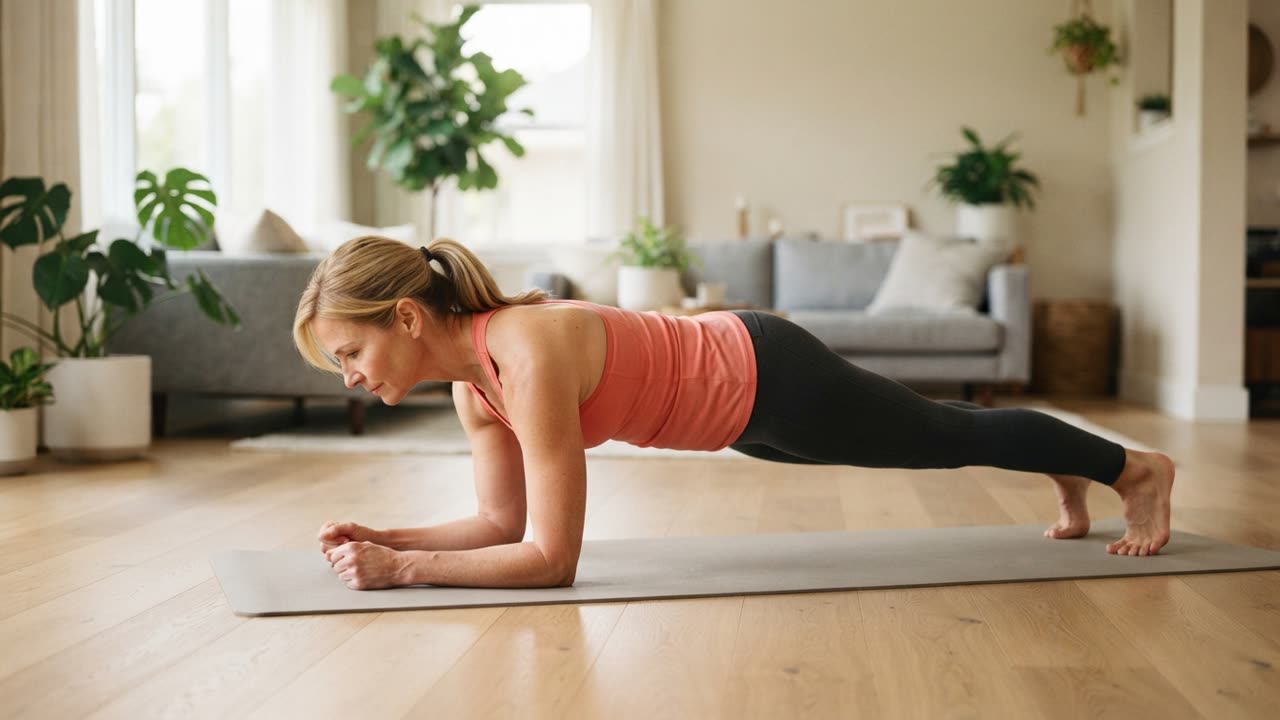
| Core | Front plank | Dead bug | Hollow body hold |
Only use a table or chair that is stable and cannot tip. Stop any exercise that causes sharp pain in a joint.
How many sets and reps should you do?
Pick a variation that brings you close to failure within your target range, and do 2 to 3 sets of it. The research above shows that both moderate and high rep sets can build muscle when you take them close to failure, so a rep range around 8 to 20 is a practical target. If you can do much more than that, move up a rung on the ladder so your sessions do not drag on.
Total weekly sets matter too. The beginner muscle-building guide explains the research on weekly volume and why roughly 6 to 10 hard sets per muscle per week is a sensible starting target.
Sample bodyweight workout to build muscle
Do this full-body session three times a week on non-consecutive days, for example Monday, Wednesday and Friday. Choose the ladder rung for each exercise that lets you reach the target reps with your last rep or two feeling hard.
| Exercise | Sets x reps | Rest |
|---|---|---|
| Split squat (or rear-foot-elevated) | 3 x 8 to 15 per leg | 90 sec |
| Push-up (your ladder rung) | 3 x 8 to 20 | 90 sec |
| Inverted row or chin-up negatives | 3 x 6 to 15 | 90 sec |
| Single-leg glute bridge | 2 x 10 to 20 per leg | 60 sec |
| Pike push-up | 2 x 6 to 15 | 90 sec |
| Dead bug | 2 x 8 to 12 per side | 60 sec |
Log each set. When you hit the top of the rep range on all sets for two sessions in a row, move to the next rung or add load with a backpack.
For a gentler starting point, try our full-body home workout for beginners. For more exercise ideas, see our guide to home workouts without equipment. The app also has 79 no-equipment workout plans with video demos for each exercise if you prefer to follow a plan.
Does diet matter for bodyweight muscle gain?
As much as with weights. Your muscles need protein to grow, whatever you train with. The International Society of Sports Nutrition’s position stand on protein recommends 1.4 to 2.0 g per kg of body weight per day for people who exercise, which works out to about 0.6 to 0.9 g per pound.
Eating enough total calories matters as well. If you are trying to lose fat at the same time, keep protein high and expect slower muscle gains. The pillar guide covers calorie targets for building muscle in detail.
When should you add weights?
Consider adding equipment when progress on a pattern stalls even after you have used the levers above, or when your sessions get long because you need very high reps. Legs and back usually reach this point first.
You do not have to join a gym. A pair of adjustable dumbbells, a set of resistance bands and a doorway pull-up bar cover most needs and fit in a closet. Mixing them with your bodyweight work keeps progression simple for years.
Bottom line
Bodyweight exercises can build real muscle, especially for beginners, as long as you push sets close to failure and keep moving to harder variations. Plan around the weak spots by using single-leg exercises and finding something to pull on. When progress stalls, a few cheap pieces of equipment are the easiest way to keep growing.
FAQ
Can you build big legs with bodyweight exercises?
You can build noticeable leg muscle with single-leg work such as split squats, step-ups and single-leg hip hinges. Legs are strong, though, so two-leg squats get easy fast, and adding a loaded backpack or dumbbells helps most people keep progressing.
How many days a week should I do bodyweight training to build muscle?
Three full-body sessions a week is a good start for beginners. It lets you train each muscle several times while leaving a rest day between workouts.
Is calisthenics better than weights for muscle growth?
Neither is better when effort and progression are equal. Weights make it easier to add resistance in small steps and to train legs and back, while calisthenics needs little equipment and builds control of your own body.
Do I need a pull-up bar?
It helps a lot, because pulling movements are hard to load without one. A sturdy table for inverted rows or a resistance band anchored in a door are workable alternatives.
This article is general information, not medical advice. Check with a doctor before starting a new exercise or diet program, especially if you have a health condition or injury.