Full Body Workout at Home for Beginners: 3-Day Plan
A full body workout at home for beginners: one 30-minute routine, 3 days a week, with easy, medium and hard levels for every move and no equipment.
By Home Workout Planner Team · · 7 min read
A good full body workout at home for beginners uses six bodyweight exercises (squat, push-up, glute bridge, lunge, upper-back raise and a core move), done 3 days a week with a rest day between sessions. Each session takes about 30 minutes, needs no equipment, and gets harder as you move from the easy to the hard version of each exercise.
This plan is for you if you are new to exercise or returning after a break and want one simple routine to repeat. If you want a deeper look at movement patterns, cardio and a two-workout split, read our full guide to home workouts without equipment.
Why train full body as a beginner?
Full-body sessions hit every major muscle group each time you train. With three sessions a week, each muscle gets worked three times, and you never fall behind if you miss a day.
It also lines up with the guidelines. The CDC says adults need at least 2 days of muscle-strengthening activity each week, plus 150 minutes of moderate aerobic activity. The American College of Sports Medicine’s resistance training position stand recommends 2 to 3 sessions a week for novices, using a load you can lift for 8 to 12 reps. Three full-body sessions meet both.
Can a bodyweight workout build muscle?
Yes, if each set is challenging. In an eight-week study, push-ups built similar muscle and strength to a low-load bench press when both groups trained twice a week with 3 sets to failure, and the push-up difficulty was adjusted by changing body position.
That last part is the key. You make bodyweight exercises harder by changing the version, not by adding endless reps. For more on this, see can you build muscle with bodyweight.
The full body workout at home for beginners
Do this same workout 3 times a week. Pick the level for each exercise that lets you do 8 to 12 reps with good form, where the last couple of reps feel hard.
| # | Exercise | Sets x reps | Rest |
|---|---|---|---|
| 1 | Squat | 3 x 8 to 12 | 60 to 90 s |
| 2 | Push-up | 3 x 8 to 12 | 60 to 90 s |
| 3 | Glute bridge | 3 x 8 to 12 | 60 to 90 s |
| 4 | Reverse lunge | 2 x 8 to 12 per leg | 60 to 90 s |
| 5 | Prone Y-T-W raise | 2 x 8 to 12 | 60 s |
| 6 | Dead bug | 2 x 6 to 8 per side | 45 s |
Why 60 to 90 seconds of rest? A 2024 meta-analysis on rest between sets found a small muscle-growth benefit from resting more than 60 seconds and no clear extra benefit past 90 seconds.
How to do each exercise
1. Squat
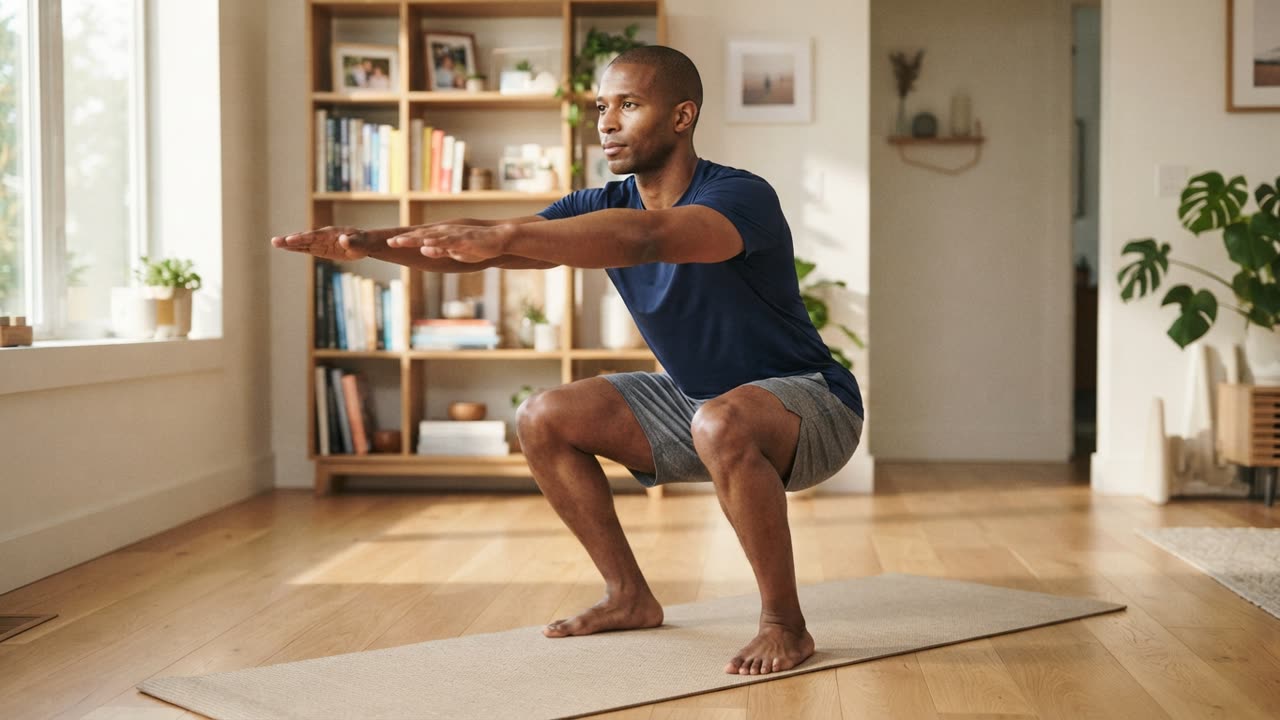
Stand with feet about shoulder-width apart. Sit your hips back and down, keep your chest up and your heels on the floor, then stand back up. Your knees should point the same way as your toes.
2. Push-up
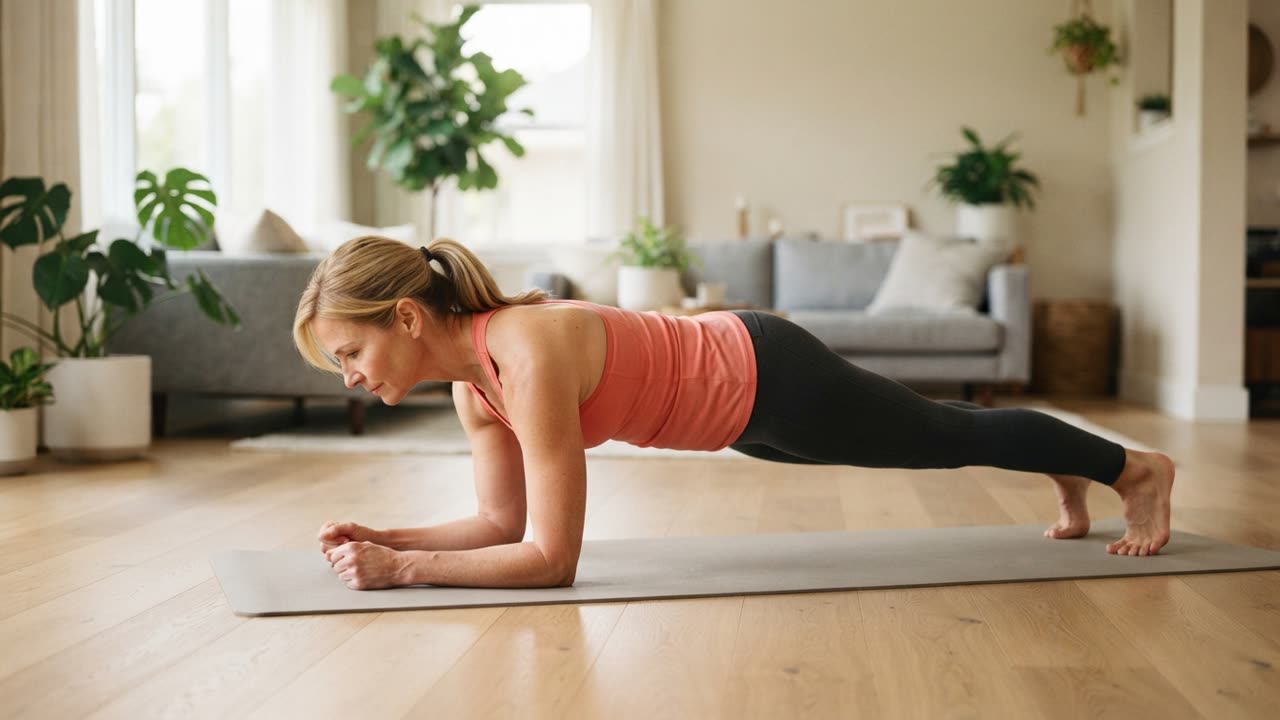
Place your hands slightly wider than your shoulders. Keep your body in a straight line from head to heels (or knees), lower your chest toward the surface, then press away.
3. Glute bridge
Lie on your back, knees bent, feet flat. Push through your heels to lift your hips until your knees, hips and shoulders line up. Squeeze your glutes for a second at the top.
4. Reverse lunge
Step one foot back and lower until both knees are bent. Keep most of your weight on the front foot, then push through it to return to standing. Finish all reps on one leg, then switch.
5. Prone Y-T-W raise
Lie face down with your forehead on a folded towel. Lift your arms off the floor in a Y shape, lower, then a T, then a W. Each letter counts as one rep. Squeeze your shoulder blades together as you lift.
6. Dead bug
Lie on your back with arms pointing at the ceiling and knees bent at 90 degrees over your hips. Press your lower back into the floor, then slowly lower your right arm and left leg toward the floor. Return and switch sides.
Easy, medium and hard versions of each move
Start every exercise at the level where 8 reps feels challenging. When you can do 12 good reps on every set, move to the next column.
| Exercise | Easy | Medium | Hard |
|---|---|---|---|
| Squat | Box squat to a chair | Bodyweight squat | Pause squat (2-second hold at bottom) |
| Push-up | Hands on a kitchen counter | Hands on a sturdy chair or knees on floor | Full push-up on the floor |
| Glute bridge | Two-leg bridge | Bridge with 2-second hold at top | Single-leg bridge |
| Reverse lunge | Holding a chair for balance | No support | Split squat, staying down for all reps |
| Y-T-W raise | Arms only, short range | Full range, 1-second hold | Reverse snow angels |
| Dead bug | Move legs only | Opposite arm and leg | Slower, 3 seconds each way |
It is normal to be at different levels on different exercises. You may find squats much easier than push-ups at first.
If you prefer to follow along on screen, the app’s beginner bodyweight plans include a video demo for every exercise, which helps when you are checking your form on a new level.
Sample week
| Day | What to do |
|---|---|
| Monday | Full body workout |
| Tuesday | 30 to 45 minute brisk walk |
| Wednesday | Full body workout |
| Thursday | 30 to 45 minute brisk walk |
| Friday | Full body workout |
| Saturday | Longer walk or other activity you enjoy |
| Sunday | Rest |
The walks take care of the CDC’s 150-minute aerobic target. If Monday, Wednesday and Friday do not suit you, any three days work as long as there is a day off between them.
Warm-up (5 minutes)
- March on the spot for 2 minutes.
- Do 10 arm circles in each direction.
- Do 10 slow box squats to a chair.
- Do 10 glute bridges.
- Do 5 counter push-ups.
How to progress over your first 4 weeks
Follow this schedule. The aim is to finish week 4 able to do more than you could in week 1, not to be exhausted after every session. If you want a full 4-week calendar with two alternating workouts, see our home workout plan.
| Week | What changes |
|---|---|
| 1 | Do 2 sets of every exercise. Stop each set with about 3 reps left in the tank. Focus on form. |
| 2 | Do the full number of sets in the table. Stop with about 2 reps left. |
| 3 | Add 1 to 2 reps per set, or slow the lowering phase to 3 seconds. |
| 4 | Move up a level on any exercise where you reached 12 reps on every set. |
After that, keep repeating the cycle: add reps until you hit 12, then move up a level. Write down your level and reps for each exercise after every session so you know what to beat next time.
Should you do it as a circuit?
You can. Instead of finishing all sets of one exercise before moving on, do one set of each exercise in a row, rest 90 seconds, and repeat for 2 or 3 rounds.
Circuits save time and get your heart rate up. The trade-off is that you may tire faster and your form can slip on the later exercises. Straight sets are the better choice in weeks 1 and 2, while you are still learning the moves.
Common beginner mistakes
Picking a version that is too easy. If you can do 20 squats without slowing down, you are building endurance more than strength. Move up a level.
Rushing the reps. Control the lowering phase. Fast, bouncy reps make every exercise easier and harder to learn.
Skipping the back and core work. Push-ups and squats feel productive, but the bridge, Y-T-W raise and dead bug balance out the plan and support your posture.
Ignoring pain. Burning in the working muscle is normal. Sharp or joint pain is not. Stop, switch to an easier version, and talk to a doctor or physical therapist if it persists. Check with a doctor before starting if you are pregnant or have a heart condition.
What comes after this plan?
Once you are moving up levels steadily, you have a few options. You can keep climbing the levels, switch to the two-workout split in our home workouts without equipment guide, or add a resistance band for more pulling work.
If your goal is muscle gain, read how to build muscle for beginners for the eating and recovery side. If you want to lose fat, the workout helps most when paired with a modest calorie deficit.
Bottom line
A full body workout at home for beginners only needs six exercises, done 3 days a week with a rest day between. Choose the version of each move that makes 8 to 12 reps hard, rest 60 to 90 seconds, and move up a level when 12 reps feels easy. Add regular walks and track your numbers, and you will have a plan you can keep using for months.
FAQ
Is a full body workout 3 times a week enough for a beginner?
Yes. Three full-body sessions train every major muscle three times a week, which is more than the 2 days of muscle-strengthening activity that public health guidelines ask for.
Should I do the exercises as a circuit or one at a time?
Either works. Straight sets (all sets of one exercise, then the next) make it easier to keep good form. Circuits save time and raise your heart rate more.
What if I cannot do a single push-up yet?
Start with push-ups against a kitchen counter or a wall. Lower the surface over the following weeks and you will build up to the floor.
Can I do this workout on consecutive days?
It is better to leave a day between sessions so your muscles recover. If your schedule forces back-to-back days, keep the second session easier.
This article is general information, not medical advice. Check with a doctor before starting a new exercise or diet program, especially if you have a health condition or injury.