Home Workout Plan: 4 Weeks, No Equipment Needed
A 4-week home workout plan with no equipment: 3 short strength days, easy walks and week-by-week progression you can start today.
By Home Workout Planner Team · · 11 min read
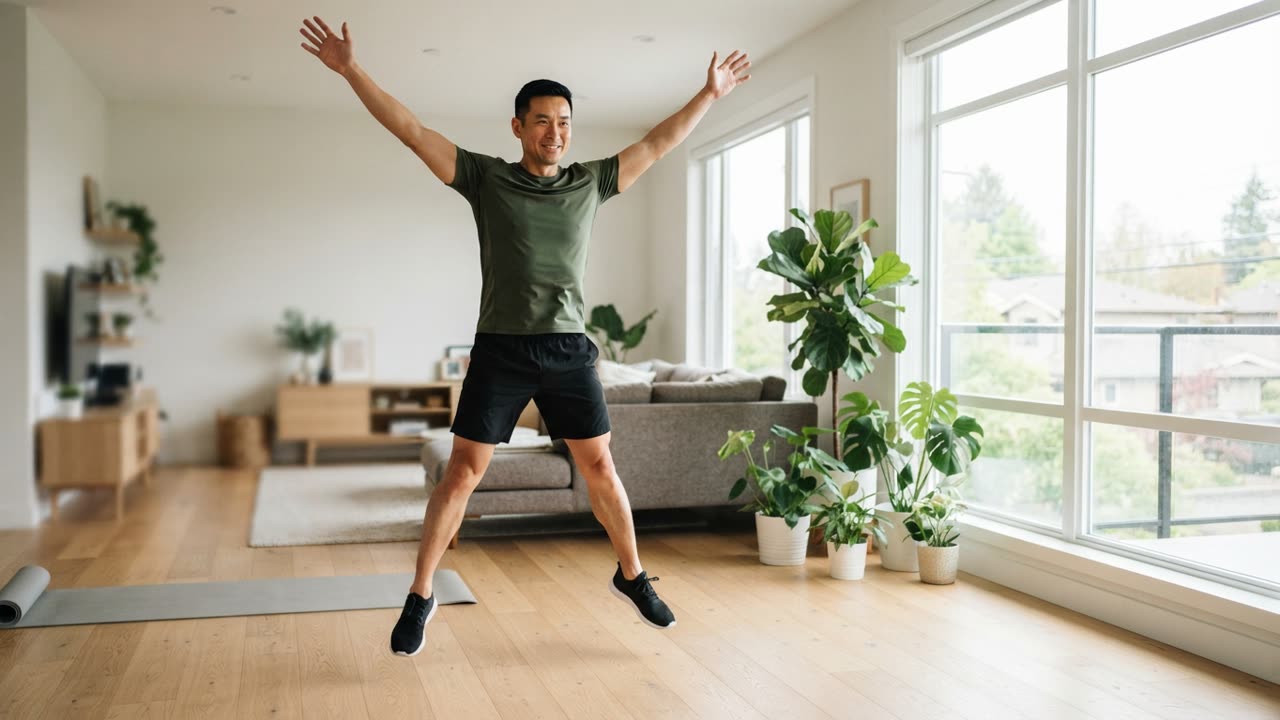
A good home workout plan for beginners has 3 strength days a week, each about 30 minutes, built from 6 or 7 bodyweight moves, plus easy walking on the other days. Over 4 weeks you add sets, reps and harder exercise versions in small steps. You need a floor, a sturdy chair and a wall or kitchen counter.
This plan is for you if you want to know exactly what to do each day, without buying anything. It is written for beginners and people returning after a break. If you want the bigger picture first, read our guide to home workouts without equipment.
What should a home workout plan include?
A plan that works has four parts: strength work for all major muscle groups, some aerobic activity, rest days, and a way to make things harder over time.
The CDC says adults need at least 150 minutes of moderate-intensity aerobic activity a week and muscle-strengthening activities on 2 or more days a week that work the legs, hips, back, abdomen, chest, shoulders and arms. This plan covers both: three strength sessions and a few brisk walks.
For the strength part, the American College of Sports Medicine’s position stand on resistance training gives 2 to 3 days per week as the frequency for novices. Three days sits at the top of that range and gives each muscle enough practice to improve.
Progression is the piece most free plans skip. Doing the same 10 squats for a month stops working. Here, every week changes something: sets, reps, tempo or exercise level.
The 4-week home workout plan at a glance
You do two workouts, A and B, and alternate them. Week 1 is A, B, A. Week 2 is B, A, B, and so on. Every workout starts with the 5-minute warm-up below.
| Day | Week 1 and 3 | Week 2 and 4 |
|---|---|---|
| Monday | Workout A | Workout B |
| Tuesday | 20 to 30 minute walk | 20 to 30 minute walk |
| Wednesday | Workout B | Workout A |
| Thursday | 20 to 30 minute walk | 20 to 30 minute walk |
| Friday | Workout A | Workout B |
| Saturday | Longer walk or any activity you enjoy | Longer walk or any activity you enjoy |
| Sunday | Rest | Rest |
Any three non-consecutive days work. If your week is chaotic, aim for the workouts and treat the walks as a bonus.
Warm-up (5 minutes)
- March on the spot for 2 minutes.
- Do 10 arm circles each way.
- Do 10 slow squats to a chair.
- Do 10 glute bridges.
- Do 5 push-ups against a counter.
Workout A: squat, push and core
| # | Exercise | Sets x reps | Rest |
|---|---|---|---|
| 1 | Squat | See progression | 60 to 90 s |
| 2 | Push-up | See progression | 60 to 90 s |
| 3 | Glute bridge | See progression | 60 s |
| 4 | Plank | 3 x 15 to 30 s | 45 s |
| 5 | Bird dog | 2 x 6 per side | 45 s |
Workout B: lunge, pull and core
| # | Exercise | Sets x reps | Rest |
|---|---|---|---|
| 1 | Reverse lunge | See progression | 60 to 90 s |
| 2 | Pike push-up (shoulder press) | See progression | 60 to 90 s |
| 3 | Prone Y-T-W raise | See progression | 60 s |
| 4 | Dead bug | 2 x 6 per side | 45 s |
| 5 | Wall sit | 3 x 20 to 40 s | 45 s |
Rest times are a guide. If you are breathing hard, take longer.
How do I do each exercise?
Learn the movement before you chase reps. Stop any set if you feel sharp or joint pain.
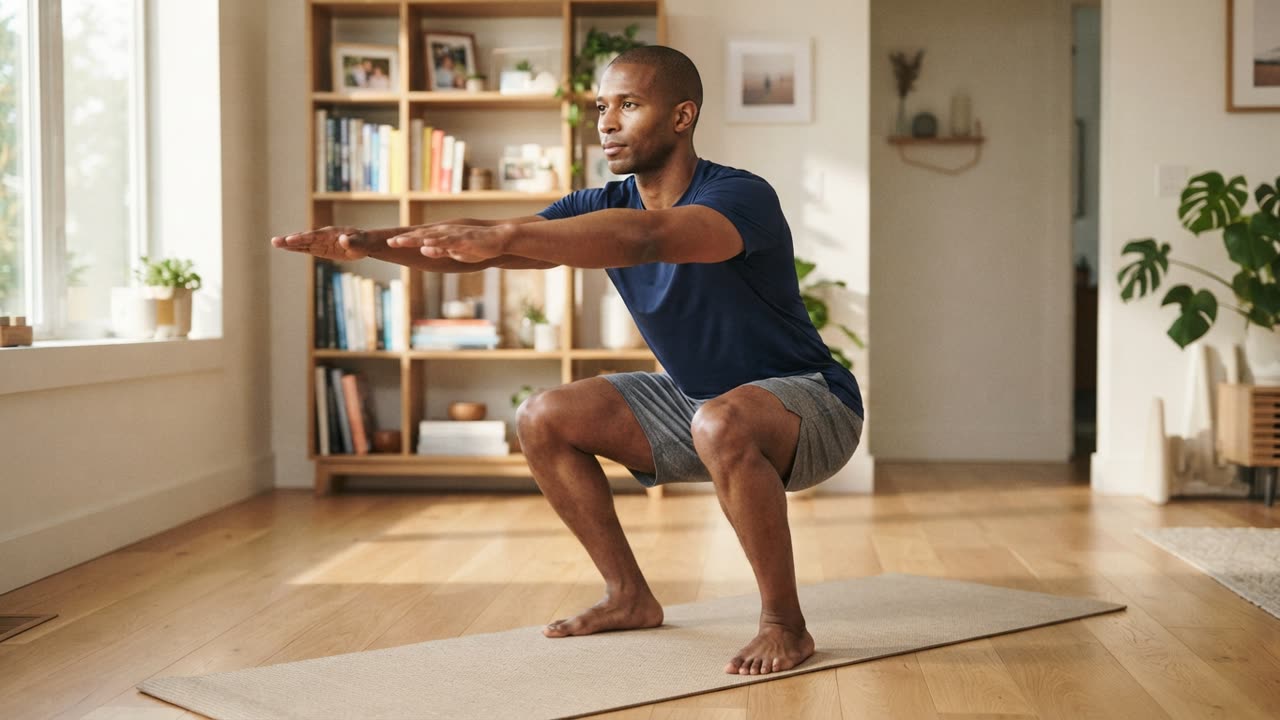
Squat
Stand with feet shoulder-width apart. Push your hips back and down as if sitting into a chair, keep your chest up and heels on the floor, then stand. Your knees track the same direction as your toes. If it is hard, squat down to a chair and stand without using your hands.
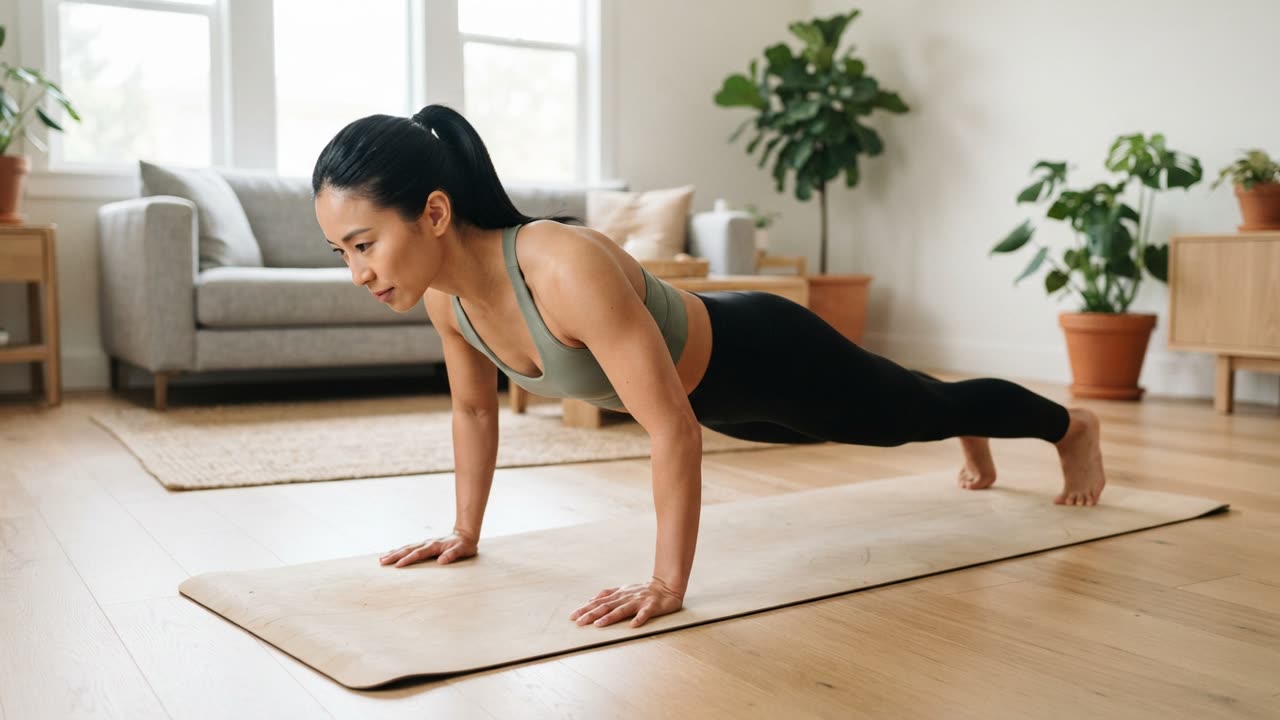
Push-up
Place your hands slightly wider than your shoulders. Keep a straight line from head to heels, lower your chest toward the surface, then press away. Start with hands on a kitchen counter and lower the surface over the weeks: counter, then chair, then knees, then floor.
Glute bridge
Lie on your back with knees bent and feet flat. Push through your heels to lift your hips until your knees, hips and shoulders line up. Pause for a second at the top.
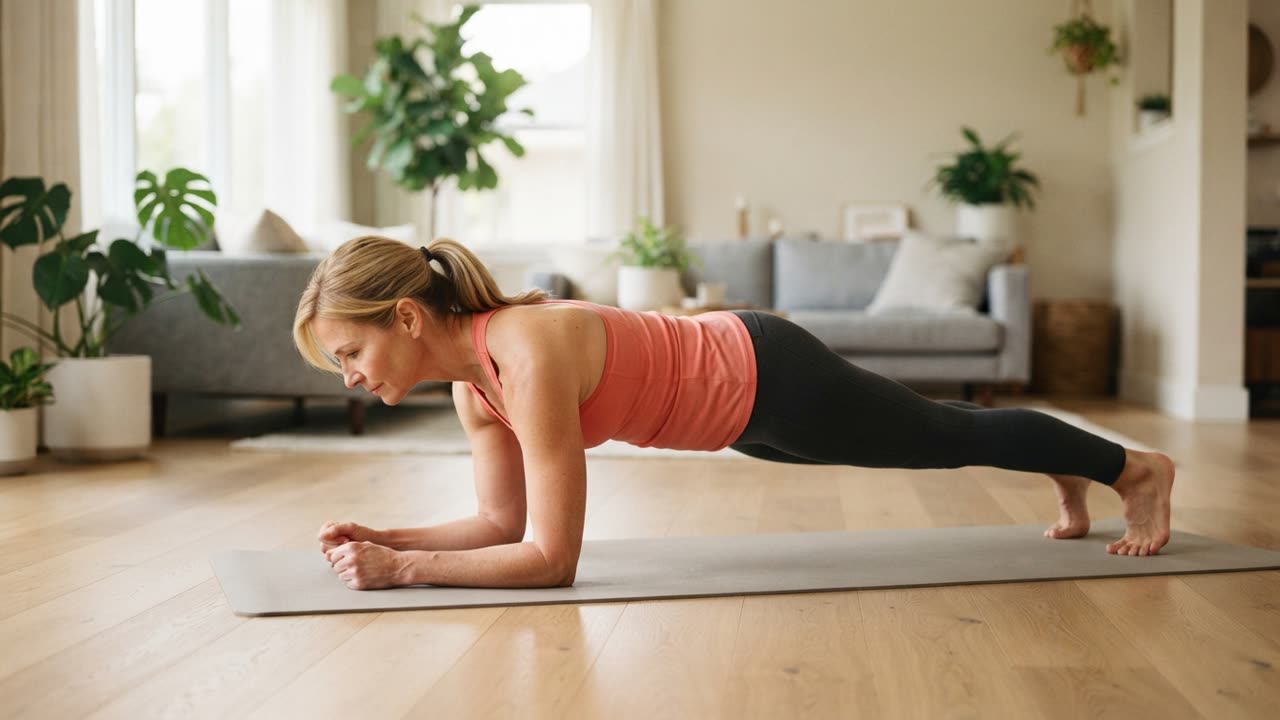
Plank
Rest on your forearms and toes (or knees) with your body in a straight line. Squeeze your glutes and keep your ribs down. Stop when your form slips, even if the timer says otherwise.
Bird dog
Start on hands and knees. Reach your right arm forward and left leg back, hold for 2 seconds without twisting your hips, then switch.
Reverse lunge
Step one foot back and lower until both knees bend. Keep most of your weight on the front foot, then push through it to stand. Finish all reps on one leg before you switch. Hold a chair or wall for balance if you need it.
Pike push-up
Start in a downward-dog shape with hips high. Bend your elbows to lower your head toward the floor between your hands, then press back up. The easier version is a pike with your hands on a chair seat and your feet on the floor.
Prone Y-T-W raise
Lie face down with your forehead on a folded towel. Lift your arms in a Y shape, lower, then a T, then a W. Each letter is one rep. Squeeze your shoulder blades together on each lift.
Dead bug
Lie on your back with arms pointing up and knees bent at 90 degrees over your hips. Press your lower back into the floor, lower your right arm and left leg toward the floor, return and switch.
Wall sit
Slide your back down a wall until your thighs are close to parallel with the floor, with knees over your ankles. Keep your back flat against the wall and breathe normally.
What changes each week?
This table gives sets and reps for the three main moves in each workout (squat, push-up, glute bridge in A; lunge, pike push-up, Y-T-W in B). The plank, bird dog, dead bug and wall sit stay as written, but lengthen the holds as they get easy.
| Week | Sets x reps | Effort and focus |
|---|---|---|
| 1 | 2 x 8 | Stop with about 3 reps left in reserve. Learn the form. |
| 2 | 3 x 8 | Stop with about 2 reps left. |
| 3 | 3 x 10 to 12 | Slow the lowering phase to 3 seconds on every rep. |
| 4 | 3 x 8 to 12 | Move up one level on any move where you reached 12 reps on every set. |
“Reps in reserve” means how many more good reps you could do. The last set of each move should feel hard in weeks 3 and 4, but your form should stay clean.
Easy, medium and hard versions
Start each move at the level where 8 reps feels challenging.
| Exercise | Easy | Medium | Hard |
|---|---|---|---|
| Squat | Squat to a chair | Bodyweight squat | 2-second pause at the bottom |
| Push-up | Hands on a counter | Hands on a chair or knees on floor | Full push-up on the floor |
| Glute bridge | Two-leg bridge | 2-second hold at the top | Single-leg bridge |
| Reverse lunge | Holding a wall | No support | Split squat (back foot behind you, stay down) |
| Pike push-up | Hands on a chair | Hands on the floor, knees bent | Feet on the chair |
| Y-T-W raise | Short range | Full range, 1-second hold | Hold each letter for 3 seconds |
It is normal to sit at different levels on different moves. Many people find squats easy and push-ups hard.
Will a bodyweight plan really build strength?
For a beginner, yes, as long as the sets are challenging. In an eight-week study of 18 young men, push-ups with the body position adjusted to match a 40% one-rep-max load produced muscle growth and strength gains comparable to a bench press at the same load, training twice a week for 3 sets. The sample was small and the participants were untrained, so treat it as encouraging evidence for beginners rather than proof for everyone.
The lesson is to make the move harder by changing the version: more range, slower tempo, a lower surface. Our post on building muscle with bodyweight covers this in more detail, and the guide to how to build muscle for beginners adds food and recovery.
How should I set up my space and my week?
You need less than you think.
- A clear floor area about the size of a yoga mat. A towel or carpet works if the floor is hard.
- A sturdy chair or sofa edge for squats and incline push-ups.
- A wall or kitchen counter for wall sits and counter push-ups.
- A timer on your phone for planks and rest.
Pick a fixed time. Many people do best by attaching the workout to something that already happens, such as right after getting home. Put the days on your calendar for the full 4 weeks. Phone reminders help, and ticking off each session on a paper calendar works well too.
What about cardio and food?
The walks on the off days are your aerobic base. Brisk walking counts as moderate activity if you can talk but not sing. If you want more, add a fourth walk or lengthen one of them. Build toward the CDC’s 150 minutes slowly, for example by adding 10 minutes a week.
On food, nothing about this plan requires a special diet. If your goal is fat loss, you need a modest calorie deficit, and how to create a calorie deficit explains how to set one without crash dieting. If you are not sure how much you eat now, how to count calories walks you through tracking.
What does a typical session look like?
Here is Workout A in week 1, start to finish, so you know what to expect.
- Warm up for 5 minutes.
- Do 2 sets of 8 squats, resting 60 to 90 seconds between sets.
- Do 2 sets of 8 push-ups at the level that leaves about 3 reps in reserve.
- Do 2 sets of 8 glute bridges.
- Hold a plank for 15 to 20 seconds, 3 times.
- Do 6 bird dogs per side, twice.
That adds up to roughly 25 minutes including rests. In week 3 the same session takes closer to 35 minutes because there are more reps, slower lowering and longer holds. Put your phone down between sets so you are not stretching 30 minutes into an hour.
Who should change this plan?
Most healthy adults can follow it as written. A few people should adjust.
- Older adults: stay on the easy versions longer and add balance support such as a wall or chair for every standing move.
- People with a heart condition, high blood pressure or other medical issues: ask your doctor which activities are safe before week 1.
- Pregnant women: get guidance from your doctor or midwife, since some positions (lying flat on your back for long, for example) change as pregnancy progresses.
- Anyone with a past injury: use pain-free ranges only, and see a professional rather than pushing through.
The home workouts guide gives more background on bodyweight training basics.
How do I know the plan is working?
Do not rely on the scale alone. Track three simple things in a notebook or the app:
- Your level and reps for each move after every session.
- How you feel at the end of week 4 compared with the end of week 1 (energy, how stairs feel).
- A photo or waist measurement at the start and the end, if you want one.
If you completed all 12 workouts, you have built a habit and a base. Most people see the clearest change in the numbers on their notebook page: more reps, a harder push-up level, a longer plank.
What if the plan feels too easy or too hard?
Too hard: stay on the easy version, cut one set from each move, and take an extra rest day. Repeat the week before you move on. Too easy: go to the next level, or finish with an extra set at the end of the last move.
Soreness for a day or two after the first week is common. Pain that is sharp, stays in one joint or gets worse is a reason to stop and see a professional. Talk to a doctor before starting if you have a heart condition or are pregnant.
What comes after week 4?
Repeat the plan from week 1 with every move one level harder, since that restarts the same low-stress progression at a higher level. After a second cycle, you will likely be ready for more variety. The full body home workout for beginners is a good next step for a simpler single-routine format, and the app has longer programs such as its 12-week home plans and 30-day challenges, with video demos for every exercise. Some features need premium.
Bottom line
Three 30-minute workouts a week, a few easy walks and small weekly increases are enough to build a base at home. Follow the order, pick the version of each move that is challenging but clean, and write down what you do. After 4 weeks, repeat the plan one level harder.
FAQ
How many days a week should I follow a home workout plan?
Three strength days plus some walking suits most beginners. Public health guidelines ask for muscle-strengthening on at least 2 days a week, and a third day gives you room to miss one.
Can I do this plan if I have never exercised before?
Yes. Every move has an easier version, and week 1 uses only 2 sets with reps to spare. If you have a medical condition, are pregnant or have not exercised in years, check with your doctor first.
What do I do after the 4 weeks are over?
Repeat the plan and start each exercise one level harder. When you have moved up on most moves, switch to a plan with more variety, such as an intermediate bodyweight program.
Do I need to eat differently to follow this plan?
No. Eat enough to feel energized for your sessions. If fat loss is your goal, a modest calorie deficit does that work, and the workouts help you keep muscle while you do it.
What if I miss a workout?
Do it the next day, or skip it and carry on with the next one in the order. Do not double up. One missed session does not change your results.
This article is general information, not medical advice. Check with a doctor before starting a new exercise or diet program, especially if you have a health condition or injury.